


📘 Product Description
TOMER DEVORAH
The Palm Tree of Deborah
Paperback
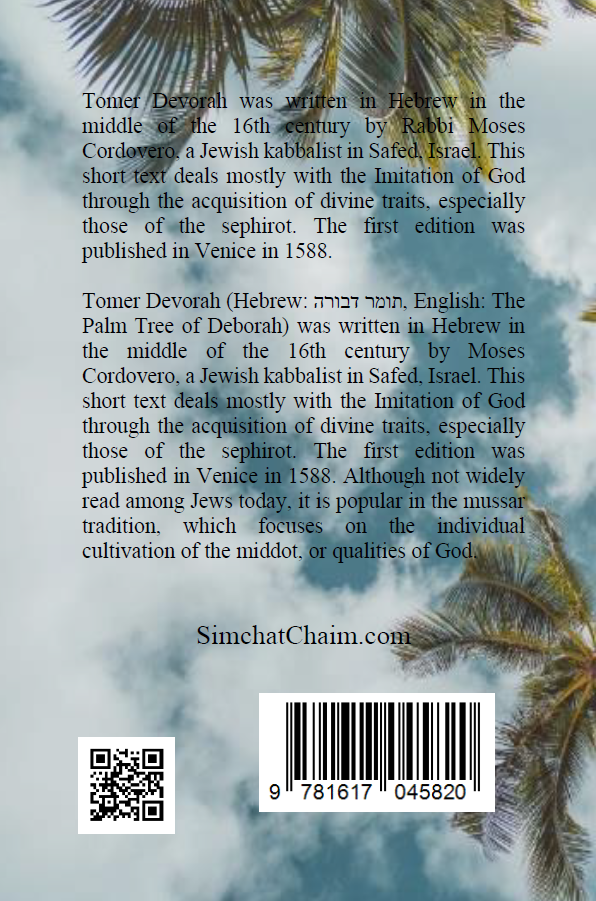
Tomer Devorah was written in Hebrew in the middle of the 16th century by Rabbi Moses Cordovero, a Jewish kabbalist in Safed, Israel. This short text deals mostly with the Imitation of God through the acquisition of divine traits, especially those of the sephirot. The first edition was published in Venice in 1588
Tomer Devorah (Hebrew: תומר דבורה, English: The Palm Tree of Deborah) was written in Hebrew in the middle of the 16th century by Moses Cordovero, a Jewish kabbalist in Safed, Israel. This short text deals mostly with the Imitation of God through the acquisition of divine traits, especially those of the sephirot. The first edition was published in Venice in 1588. Although not widely read among Jews today, it is popular in the mussar tradition, which focuses on the individual cultivation of the middot, or qualities of God.
Rabbi Moshe Cordovero
Kabbalist Rabbi Moshe Cordovero, also referred to as Ra'MaK, was a leading kabbalist who lived and taught in Tsfat. His best-known work, Pardes Rimmonim, is a systematization of various schools of kabbalistic thought. He authored many highly influential works, including a defense of kabbalah, a highly-regarded ethical work based on kabbalistic thought, and a comprehensive commentary on the Zohar. He had many disciples and was considered the premier kabbalistic authority until superseded by Rabbi Yitzchak Luria (AR"I Z"L) shortly after his death.
Rabbi Moses ben Jacob Cordovero was a central figure in the historical development of Kabbalah, leader of a mystical school in 16th-century Safed, Ottoman Syria. He is known by the acronym the Rama"k.
After the Medieval flourishing of Kabbalah, centered on the Zohar, attempts were made to give a complete intellectual system to its theology, such as by Meir ibn Gabbai. Influenced by the earlier success of Jewish philosophy in articulating a rational study of Jewish thought, Moshe Cordovero produced the first full integration of the previous differing schools in Kabbalistic interpretation. While he was a mystic inspired by the opaque imagery of the Zohar, Cordoverian Kabbalah utilised the conceptual framework of evolving cause and effect from the Infinite to the Finite in systemising Kabbalah, the method of philosophical style discourse he held most effective in describing a process that reflects sequential logic and coherence. His encyclopedic works became a central stage in the development of Kabbalah.
Immediately after him in Safed, Isaac Luria articulated a subsequent system of Kabbalistic theology, with new supra-rational doctrines recasting previous Kabbalistic thought. While Lurianism displaced the Cordoverian scheme and became predominant in Judaism, its followers read Cordoverian works in harmony with their teachings. Where to them, Lurianism described the "World" of Rectification, Cordovero described the pre-Rectification World.[3] Both articulations of the 16th-century mystical Renaissance in Safed gave Kabbalah an intellectual prominence to rival Medieval Rationalism, whose social influence on Judaism had waned after the Expulsion from Spain.
Print Details
Publisher: simchatchaim.com
Language: English
ISBN/SKU: 978-1-61704-582-0
Trim Size: 6.000" x 9.000" (229mm x 152mm)
Paper Color: White 50
Paperback: Perfect Bound
Laminate Type: Matte
Page Count: 118